The EUR/USD pair continues to rise on expectations of a ceasefire between Iran and the United States and a halt to hostilities in the Middle East. In reality, the current geopolitical backdrop could easily have triggered a renewed bearish push, but a combination of factors has finally supported bullish traders and the euro.
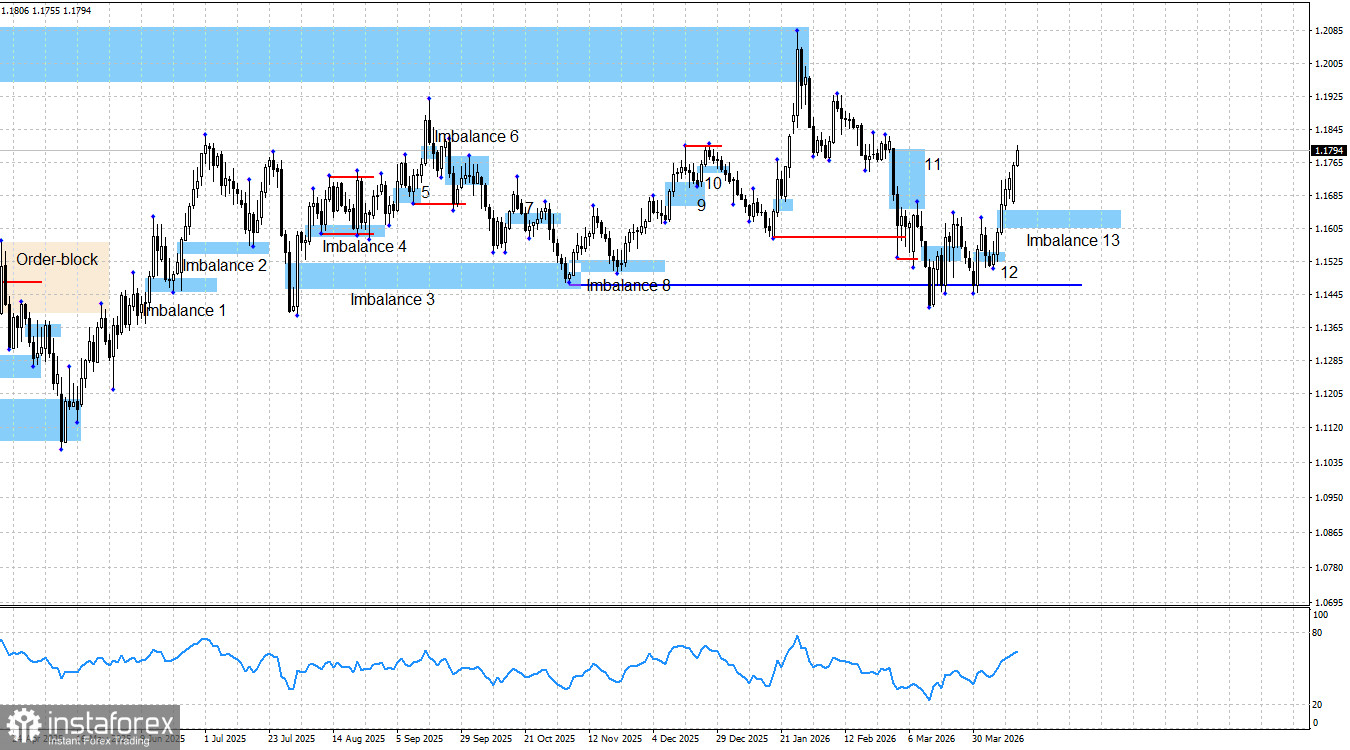
Last week, a reaction was seen from bullish imbalance 12, which marked the beginning of the bullish advance. Of course, if geopolitics had not turned against the bears, the bullish move might not have materialized. Still, patterns are not meaningless. Traders had the opportunity to open long positions, which are now showing strong profits.
Over the weekend, the geopolitical backdrop changed sharply, but traders seem to have largely ignored it—or interpreted it differently. However, what matters is that a valid buy signal formed, allowing traders to enter positions that are now highly profitable. I must admit I doubted that bulls would be able to continue pushing this week, but the outcome has been favorable.
All the strength in the U.S. dollar over the past one and a half to two months was driven solely by geopolitics. As soon as the U.S. and Iran agreed to a two-week ceasefire, bears quickly retreated and bulls surged forward. At present, the ceasefire remains fragile but is still holding despite the failure of negotiations in Islamabad.
I have repeatedly stated that I do not believe the bullish trend has ended, even after the break of key trend-forming lows. The movement of the past two months could turn into a bearish trend if geopolitics deteriorates further—but how much worse can it get? Most of the worst-case scenarios have already occurred. Markets often price in the most pessimistic outcomes in advance. Therefore, it is possible that traders have already fully priced in the Middle East conflict.
The technical picture has become clearer: the price showed no reaction to imbalance 11 and failed to resume its decline, with no sell signal formed; it then reacted to imbalance 12, generating a bullish signal within the prevailing uptrend; additionally, a new bullish imbalance (13) has formed, acting as both a potential buying zone and a support level for the euro.
The bullish advance has been so strong that the euro has not yet retraced to imbalance 13, though it may do so later.
The news background on Tuesday was weak, with almost no economic data releases. However, Donald Trump has begun blocking Iranian tankers in the Strait of Hormuz, preventing them from delivering oil to buyers. Oil is once again trading near $100 per barrel—and it is fortunate that it is around $100. These are futures prices; spot purchases could already cost at least $150.
Bulls still have plenty of reasons to stay active, and even the outbreak of conflict in the Middle East has not diminished them. Structurally and globally, Trump's policies—which contributed to a sharp decline in the dollar last year—have not changed.
In the short term, the U.S. dollar may still strengthen due to risk aversion, but this factor cannot provide lasting support. It would require continuous escalation in the Middle East, which is unlikely. There are no other strong drivers supporting the dollar. I still do not believe in a sustained bearish trend for EUR/USD. The dollar received temporary support, but what will sustain bears in the long term?
Economic calendar for the US and the Eurozone:
- Eurozone – Industrial Production (09:00 UTC)
- Eurozone – Speech by ECB President Christine Lagarde (19:30 UTC)
On April 15, the economic calendar includes two events that are not particularly significant. The impact of news flow on market sentiment on Wednesday is expected to be minimal or absent.
EUR/USD Forecast and Trading Advice:
In my view, the pair remains in the process of forming a bullish trend. The news backdrop shifted sharply two months ago, but the trend itself cannot be considered canceled or complete. In the near term, bulls may continue their advance, provided geopolitics does not dominate market attention entirely.
Traders had an opportunity to open long positions based on the signal from imbalance 12, targeting around 1.1670. This target has already been reached, and the upward movement may continue toward this year's highs. A new imbalance (13) has also formed, which could generate another bullish signal.
For uninterrupted euro growth, the Middle East conflict would need to move toward a stable peace—something that is not currently evident. However, bears are also not gaining new reasons to attack. In the near term, I would rely primarily on technical analysis.