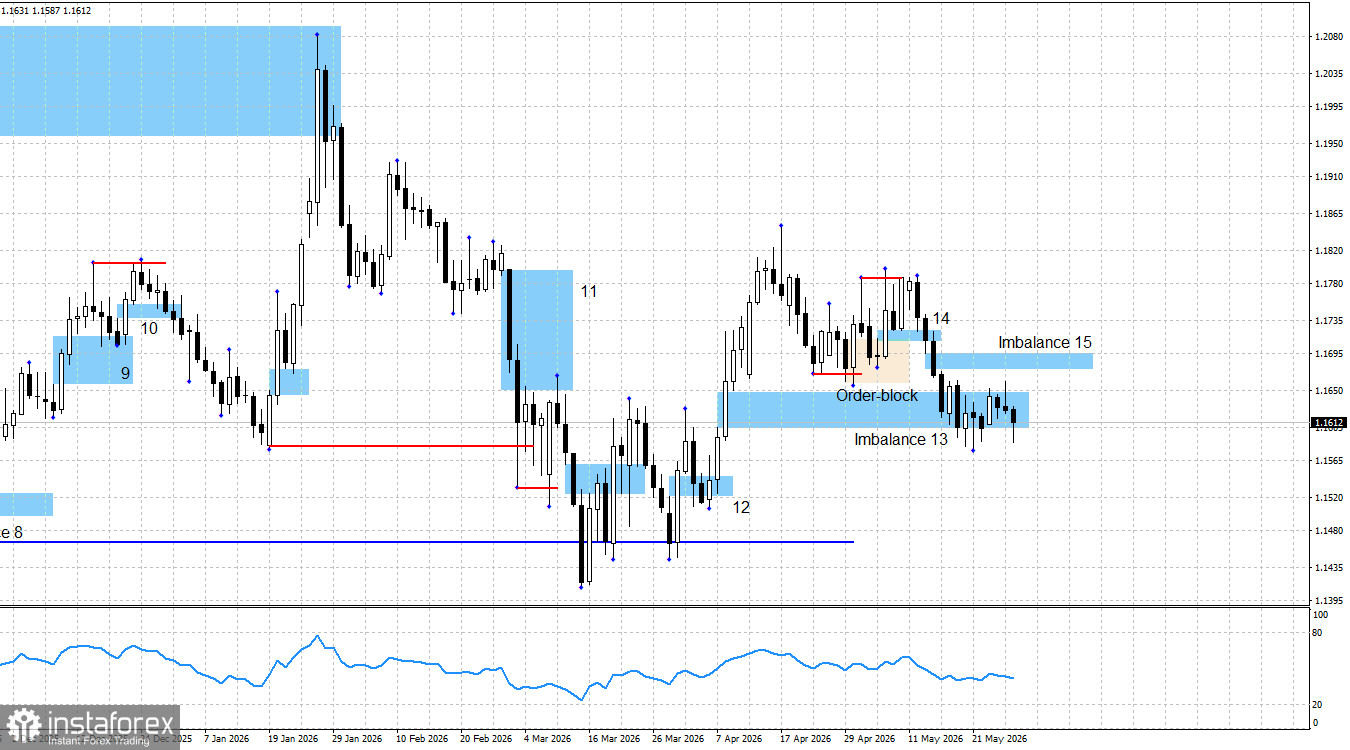
Over the past several days, the EUR/USD pair has been trying to reverse in favor of the euro and resume its upward movement in line with the bullish trend. During the last nine days, the euro has remained within imbalance 13 (the 1.1604–1.1649 level). The bears failed to invalidate this bullish pattern, which means that despite the euro's decline over the past month and a half, the bullish trend remains intact. Within a bullish trend, I prefer to look for and trade buy signals rather than sell signals. Therefore, inside imbalance 13, I am still waiting for the formation of a new buy signal. However, the euro's near-term outlook will depend not on technical analysis or trading signals, but on geopolitics.
Last week and at the beginning of this week, there were repeated reports suggesting that an agreement between Iran and the United States was close. However, on Tuesday, the United States launched new strikes on southern Iran near the port of Bandar Abbas. Then on Thursday, Iran and the United States exchanged additional strikes. Thus, at the moment, a ceasefire between Washington and Tehran remains only a distant hope. Nevertheless, the market has not completely abandoned expectations regarding negotiations and a possible agreement. It should be acknowledged that despite the ongoing strikes by both sides, negotiations are officially continuing. Despite Donald Trump's latest threats, Iran has not withdrawn from diplomatic contact. This means that the possibility of peace still exists. The only question is how long the market is prepared to wait for it.
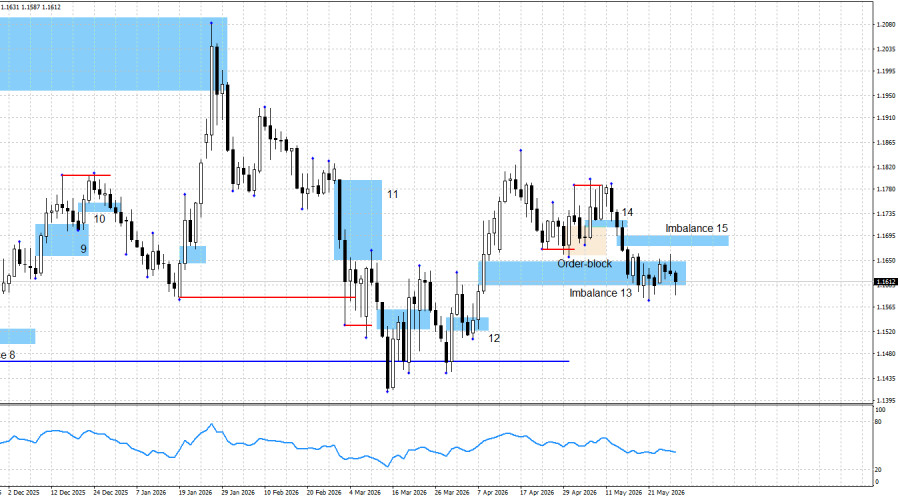
Under current conditions, traders can only wait either for another reaction from imbalance 13, which remains the latest bullish pattern within the current bullish impulse, or for its invalidation. If the pair's decline is viewed as a corrective pullback, then it may well be completed within imbalance 13. However, without geopolitical support, bullish traders will struggle to launch a new offensive. If the current movement is instead viewed as the beginning of a new bearish trend, then traders should expect negotiations to fail, the conflict to resume, and a signal to form within imbalance 15. In my opinion, the first scenario remains more likely.
Once again, I must point out that the entire appreciation of the US dollar between January and March was driven solely by geopolitics. As soon as the United States and Iran agreed to a ceasefire, the bears immediately retreated, and for more than a month the bulls dominated the market. At the moment, the chances of reaching an agreement have started to decline again. The market remains highly skeptical toward any reports suggesting that the conflict could end soon or that an agreement between Iran and the United States is close. More precisely, a deal will probably eventually be signed. However, "eventually" is not enough to support aggressive upside momentum in the pair. For example, if an agreement is signed only a year from now, traders are unlikely to become optimistic today and start aggressively selling the US dollar.
The overall technical picture currently remains clear. The bullish trend is still intact but desperately requires support. Ideally, this support should come from geopolitics — Iran and the United States signing at least a framework agreement before continuing discussions regarding Iran's nuclear program. Without a positive news backdrop, it will be difficult for the bulls to launch another offensive.
Thursday's economic background consisted of US reports on first-quarter GDP, durable goods orders, and the PCE index. However, I cannot say that the market was closely monitoring or anticipating this information. Once again, economic releases received little attention because geopolitics remains the market's primary focus.
The bulls still have many reasons to remain active in 2026, and even the outbreak of war in the Middle East has not reduced their number. Structurally and globally, Trump's policies, which caused the sharp decline of the dollar last year, have not changed. In the coming months, the US currency may occasionally strengthen amid investor flight to safety, but this factor requires constant escalation in the Middle East conflict. I still do not believe in the emergence of a long-term bearish trend for EUR/USD. The dollar has received temporary support from the market, but what fundamental drivers would allow the bears to maintain pressure over the long term?
News Calendar for the United States and the Eurozone:
- Germany – Unemployment Rate (07:55 UTC).
- Germany – Consumer Price Index (12:00 UTC).
The economic calendar for May 29 contains two events, neither of which I consider particularly important. The influence of the economic background on market sentiment on Friday may remain limited during the first half of the day.
EUR/USD Forecast and Trading Tips:
In my opinion, the pair remains in the process of forming a bullish trend. The information backdrop changed sharply three months ago, but the trend itself cannot yet be considered canceled or completed. Therefore, bullish traders may well resume their advance in the near future if geopolitics provides at least limited support.
Traders previously had opportunities to open buy positions based on the signal from imbalance 12, as well as the order block signal. The upward movement may resume toward the yearly highs from imbalance 13. However, this week it is important for the bulls to maintain market control. For the euro to continue rising without obstacles, the conflict in the Middle East must continue moving toward a stable peace agreement. Failed negotiations, rejection of a framework agreement by either side, or another ceasefire violation would quickly allow the bears to regain control. At the moment, bullish traders still lack sufficient support for a full-scale offensive. The buy zone remains 1.1605–1.1649.